By Admin

Can You Drive in Singapore as a Foreigner? What You Need to Know
Introduction
Moving to a new country comes with a long list of practical considerations, and transportation is often one of the first. While Singapore's public transport system is widely regarded as one of the best in the world, there are many situations where having access to a car offers a level of convenience and flexibility that public transport cannot always provide.
Foreigners in Singapore, however, may have questions around licence validity, driving regulations, conversion requirements, and vehicle ownership costs. Fortunately, the process is relatively straightforward once you understand the rules.
This guide explains everything you need to know about driving in Singapore as a foreigner, helping you enjoy a smoother, more confident driving experience from day one.
Key Takeaways
Foreigners can legally drive in Singapore, but the rules depend on whether they are short-term visitors, work pass holders, or permanent residents.
A valid foreign licence may be used initially, though some drivers will also require an International Driving Permit (IDP).
Long-term residents will eventually need to convert their licence and comply with local driving regulations.
Foreigners driving in Singapore should familiarise themselves with Electronic Road Pricing (ERP), parking rules, and road regulations to ensure a smoother driving experience.
Given the high cost of owning a car in Singapore, leasing can be a practical alternative for expatriates and newcomers.
Can Foreigners Drive in Singapore?
The short answer is yes. However, the requirements for foreigners driving in Singapore vary depending on their residency status, length of stay, and the type of driving licence they hold.
Licence Requirements and Eligibility
Short-Term Visitors and Long-Term Residents
Tourists and short-term social visit pass holders may generally drive in Singapore using a valid foreign driving licence for up to 12 months from their date of entry.
For those relocating to Singapore on a longer-term basis, the requirements are different. Work Pass holders, including Employment Pass (EP), S Pass (SP), and Personalised Employment Pass (PEP) holders, as well as Permanent Residents (PRs), are expected to transition to a Singapore driving licence after their initial period of residence. Beginning the conversion process early can help prevent disruptions to your ability to drive legally.
Do You Need an International Driving Permit?
Foreigners driving in Singapore without an English licence must carry an International Driving Permit (IDP). The IDP serves as an official translation and allows local authorities to verify your driving credentials. It is not a standalone licence and is only valid when presented alongside your original foreign licence.
If you are unable to obtain an IDP, an official English translation from your Embassy, High Commission, or a Singapore-registered translation service may be accepted. Drivers holding licences from certain ASEAN countries, such as Malaysia, Indonesia, and Brunei, are generally exempt from IDP requirements.
Age and Medical Requirements
The minimum legal driving age in Singapore for both foreigners and citizens is 18 years old. Drivers aged 65 and above are required to undergo a medical examination by a Singapore-registered doctor every three years to confirm that they remain fit to drive. The assessment typically covers vision, coordination, and overall physical health.
As of 2026, the process has been streamlined through the Harmonised Medical Examination Report (HMER), allowing medical practitioners to submit examination results electronically.
How to Convert to a Singapore Driving Licence
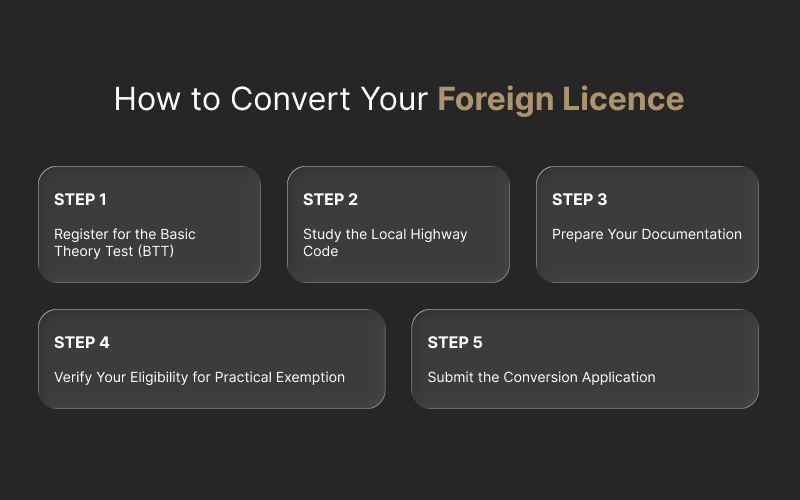
While foreigners driving in Singapore can, in the short term, use their home country’s licence, new Citizens and PRs must convert their foreign licence within 3 months of obtaining their new status.
Step 1: Register for the Basic Theory Test (BTT)
All foreign licence holders seeking conversion must first pass the Basic Theory Test (BTT). The test evaluates your understanding of Singapore's road rules, traffic signs, and driving regulations. Registration can be completed through one of Singapore's authorised driving centres.
Demand for test slots can be high, particularly for English-language sessions, so booking early is recommended.
Step 2: Study the Local Highway Code
Foreigners looking to drive in Singapore should spend time reviewing local regulations. Singapore's road rules may differ from those in your home country, particularly regarding lane discipline, bus lane restrictions, pedestrian priority, and expressway etiquette.
Step 3: Prepare Your Documentation
A complete application package typically includes:
Passport
Valid Work Pass or residency documentation
Foreign driving licence
Passport-sized photograph
Driving record or licence extract if required
Official English translation where applicable
Having everything prepared in advance helps avoid unnecessary return visits.
Step 4: Verify Your Eligibility for Practical Exemption
Many applicants are exempt from practical driving tests. However, you must demonstrate that your licence was obtained legally while residing in the issuing country. Supporting evidence may include employment records, utility bills, educational enrolment records, or other proof of residency.
If sufficient documentation cannot be produced, additional assessments may be required.
Step 5: Submit the Conversion Application
Once you have passed your BTT, visit the Traffic Police Department to submit your application in person. You will be required to pay a one-time conversion fee of $50, payable via NETS, debit card, credit card, and SGQR at the Traffic Police Headquarters service counters. Eligible drivers can access their digital driving licence through the Singpass app, while a photocard driving licence will also be provided.
Essential Road Rules for Foreigners Driving in Singapore
While much of Singapore’s road etiquette is fairly intuitive for experienced drivers, you may encounter unique systems and rules that may differ from those of your home country.
The ERP System
Singapore manages traffic flow through Electronic Road Pricing (ERP), a pay-as-you-use system in which charges are automatically deducted as you drive under designated gantries during peak periods. Rates vary depending on location, traffic conditions, and time of day.
Most vehicles are equipped with the newer On-Board Unit (OBU) system, which automatically deducts ERP charges from a linked payment card. Foreigners driving in Singapore should ensure they have sufficient funds to avoid penalties.
Digital Parking via the Parking.sg App
Singapore has largely transitioned away from traditional paper parking coupons. While most malls and commercial carparks use the automated Electronic Parking System (EPS), street-side parking requires you to use the Parking.sg mobile app. This app allows motorists to start, extend, and end parking sessions remotely. Charges are calculated based on actual usage, helping eliminate unnecessary costs.
Bus Lane Priority and Road Markings
Foreigners driving in Singapore will need to pay close attention to the coloured lane markings designed to prioritise public transport. In general:
Normal Bus Lanes (yellow) are restricted during peak hours (07:30–09:30 and 17:00–20:00 on weekdays)
Full-Day Bus Lanes (red and yellow) remain restricted from 23:00 to 23:00 from Monday to Saturday.
Drivers must also yield to buses exiting designated bays, marked by a yellow box.
Buying a Car in Singapore: Is It Worth It for Foreigners?
After becoming comfortable with local driving regulations in Singapore, many foreigners may start to consider purchasing a vehicle of their own. The answer depends largely on their lifestyle needs, duration of stay, and financial priorities.
Understanding the Cost of Car Ownership
Singapore consistently ranks among the most expensive places in the world to own a vehicle, largely due to the Certificate of Entitlement (COE).
The Certificate of Entitlement (COE)
Every vehicle owner in Singapore must secure a COE, which grants the right to own and operate a vehicle for 10 years. COE premiums frequently exceed six figures and often cost more than the vehicle itself.
Foreigners are generally eligible to participate in the COE bidding process, provided they meet the relevant requirements. Individual bidders must hold a valid Singapore-issued work pass and FIN, while companies must be locally registered entities. Bidding can be conducted through approved banking channels.
For individual bidders: DBS/POSB ATMs
For companies and motor traders: Online Banking for DBS, UOB, and Maybank
A bid deposit is also required before a bid can be submitted. The deposit amount is currently $10,000 for Categories A, B, C, and E, and $1,500 for Category D. Individual bidders are limited to one bid per bidding exercise under their own name and identification details.
Taxation (ARF and OMV)
Singapore also imposes the Additional Registration Fee (ARF), a tax levied on vehicle registration, calculated as a percentage of the car's Open Market Value (OMV). This means that luxury vehicles can attract particularly substantial taxes, making the total cost of owning these cars particularly steep.
Maintenance and Depreciation
The cost of owning a car often extends far beyond the purchase price. You’ll be responsible for:
Insurance premiums
Road tax
Servicing and maintenance
Repairs
Fuel costs
Foreigners driving in Singapore may also need to consider depreciation. Vehicles typically lose value quickly, and changes to the Preferential Additional Registration Fee (PARF) rebate structures have further reduced the amount owners can recover when deregistering eligible vehicles.
Rent, Lease, or Buy: Which Makes More Sense?
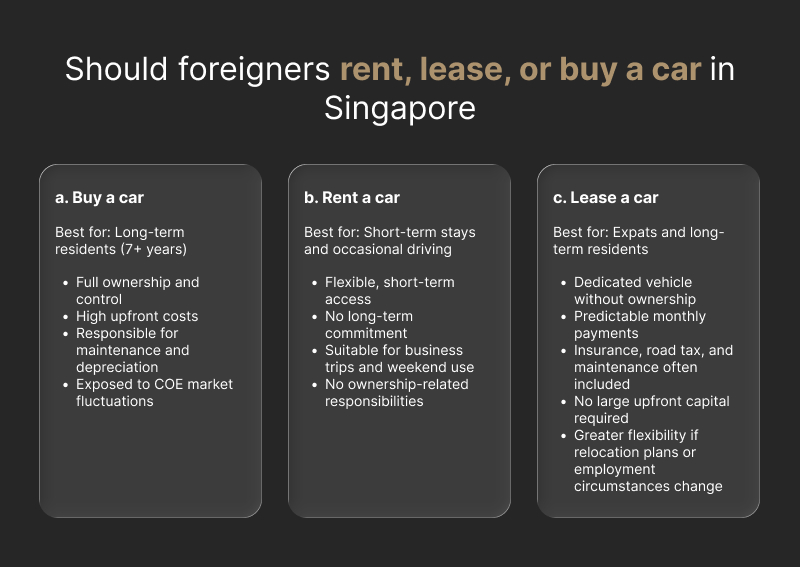
Given the significant upfront costs and ongoing expenses involved, many foreigners choose to explore alternatives to car ownership for driving in Singapore. The right option largely depends on how long you plan to stay, how frequently you drive, and the level of flexibility you require.
When You Should Buy a Car
Buying a car may make sense if you:
Plan to remain in Singapore for the long term (typically seven years or more)
Prefer full ownership and control over the vehicle
Are comfortable making a substantial upfront financial commitment
However, ownership also means bearing the risks associated with COE fluctuations, depreciation, maintenance costs, and eventual resale value.
When You Should Rent a Car (Short-Term)
Short-term car rentals allow you to access a vehicle only when needed, while avoiding the responsibilities and costs associated with ownership.
This option is generally best suited for those who:
Are visiting Singapore for a short period
Need a vehicle occasionally for weekends, holidays, business trips, or travelling across the border to Malaysia
Prefer maximum flexibility without long-term commitments
When You Should Lease a Car
Car leasing is often a popular middle ground for expats and long-term residents. It may be a suitable option if you:
Require a vehicle for several months or years
Want predictable monthly expenses
Prefer not to commit significant capital to purchasing a car
Are unsure exactly how long you will remain in Singapore, especially if future work assignments or relocation opportunities arise
Most long-term car leasing arrangements include insurance, road tax, servicing, and maintenance within a single monthly fee. This allows foreigners driving in Singapore to enjoy the convenience of having a dedicated vehicle without the financial risks and administrative responsibilities that come with ownership.
Frequently Asked Questions
1. Can foreigners lease a vehicle with their foreign driving licence in Singapore?
Yes, you can secure a lease with Eurokars Leasing using a valid foreign licence, provided you have been in Singapore for less than 12 months. During this period, you must also present your passport and a valid IDP if your licence is not in English. However, once you cross the 12-month residency mark or obtain Permanent Residency, you must produce a converted Singaporean driving licence to continue your lease and ensure your insurance coverage remains valid.
2. How do I manage ERP fees if I don't have a local bank account yet?
It is relatively easy to manage ERP charges as a foreigner driving in Singapore, even if you have not yet opened a local bank account. Most vehicles are equipped with an On-Board Unit (OBU), an ERP payment system that automatically deducts charges from a compatible payment card. Foreigners driving in Singapore can use a NETS Motoring Card, which can be purchased and topped up at convenience stores and other authorised locations. Top-ups can also be managed through the NETS mobile app using a credit or debit card.
For added convenience, short-term rental vehicles from Eurokars Leasing come with a preloaded payment card, allowing you to start driving immediately without arranging local banking first. Any subsequent top-ups can be made easily as needed throughout your rental period.
3. What should I do if I am involved in a minor traffic accident?
Foreigners who encounter an accident while driving in Singapore should exchange particulars with the other party, including names, contact details, identification numbers (NRIC or FIN), and insurance information. It is also advisable to take photographs of the vehicles, road conditions, and the surrounding scene to support any subsequent insurance claims.
If you are driving a Eurokars Leasing vehicle as a foreigner, simply contact our 24-hour accident reporting hotline for assistance. Our team will guide you through the reporting process, coordinate with the relevant insurers, and, where applicable, arrange a replacement vehicle to minimise disruption to your journey.
4. I am visiting Singapore for a business trip. Should I rent a car?
If you are in Singapore for a short-term business trip, renting a car can be a practical way to travel between meetings, client visits, and events without relying on public transport or ride-hailing services. At Eurokars Leasing, our corporate car rental solutions offer the flexibility of a dedicated vehicle throughout your stay, with insurance and maintenance typically included, so you can focus on your schedule rather than logistics.
Conclusion

Driving in Singapore as a foreigner is generally straightforward once you understand the local requirements, from licence validity and conversion timelines to road regulations and transport options. The key is to choose an approach that aligns with your needs, whether you are here for a short business assignment, a multi-year relocation, or something in between.
At Eurokars Leasing, we believe access to a vehicle should feel effortless. Through our premium car rental and leasing solutions, you can enjoy the convenience and flexibility of driving without the long-term financial commitments and administrative responsibilities that come with ownership. With flexible rental and leasing solutions backed by attentive support, every detail is thoughtfully managed so you can focus less on administration and more on making the most of driving in Singapore.
Book a car from our Eurokars Leasing Fleet today.